
David Ni
Design collaboration that stays aligned and in scope, and design decisions that are well grounded
Senior UI/UX Designer | Nearly seven years of UI/UX design experience: first designing UI for websites and mobile apps at design agencies, then spending more than five years at GLOBIS in Tokyo on a cross-platform learning service (Web, iOS, and Android). After being promoted to Senior UI/UX Designer, took on Design Lead responsibilities, coordinating four contract designers spread across teams (design reviews, design resource allocation, and more). Works in Mandarin (native), Japanese (JLPT N1), and English (TOEIC 880). Based in Taiwan and willing to relocate.
The product I worked on for more than five years
From September 2020 to February 2026, I was responsible for product design on this cross-platform learning service at GLOBIS in Tokyo. The service has about 1.4 million cumulative members, and about 80% of the 225 leading Japanese companies in the Nikkei 225 index have adopted it. During that time, I introduced frameworks for our design process and continuously improved the design system. All of the case studies below come from this work.
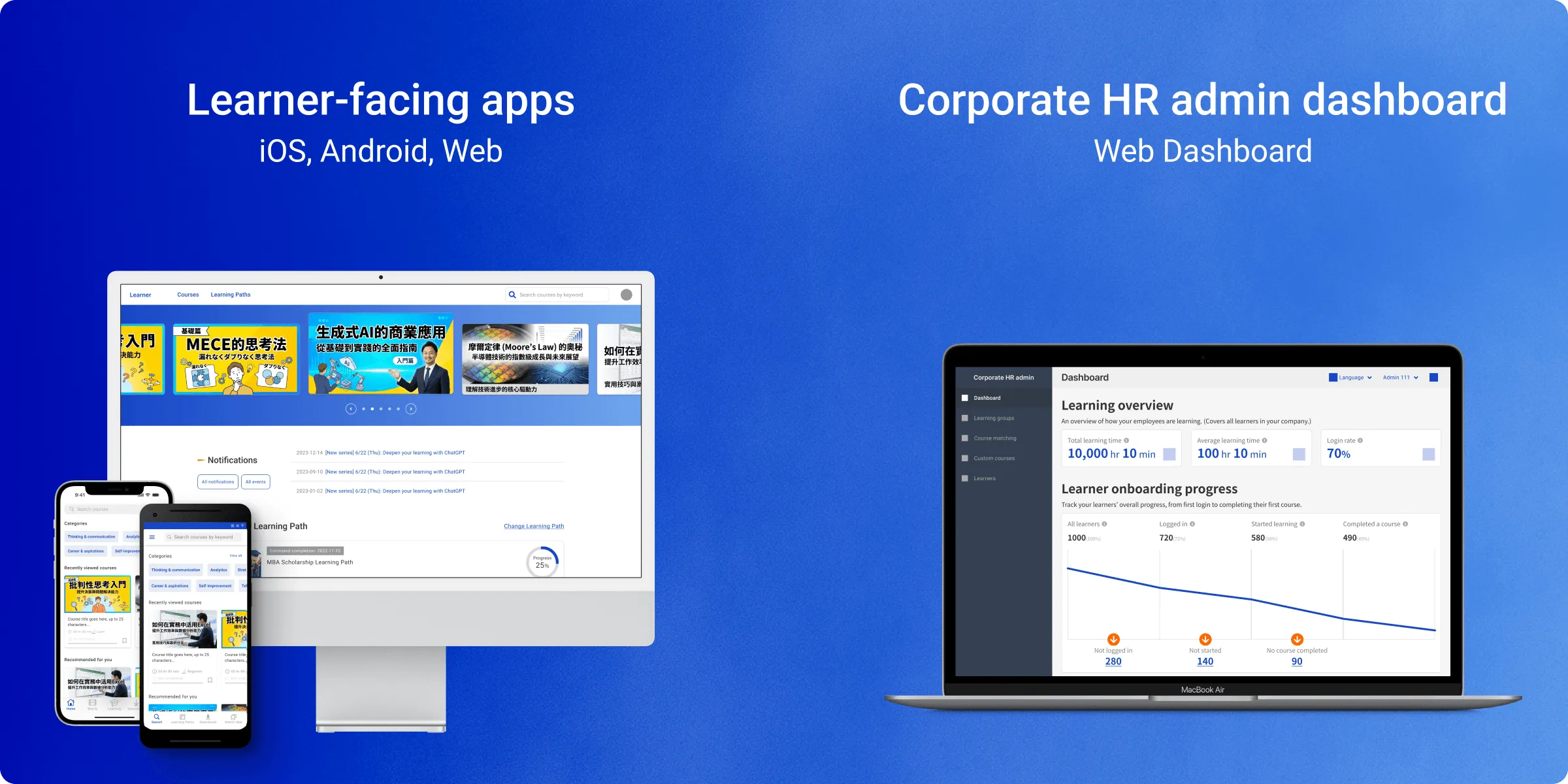
In the Japanese version: more than 4,400 courses across 16 professional categories. The service spans learner-facing apps (Web, iOS, and Android) and a corporate HR admin dashboard.
Case Studies
Each case study shows how I define a problem, break it down, and arrive at the design decisions or methods that fit. The tags on each card show the core competencies that case mainly demonstrates (see “Core competencies” below for definitions).

Using learning plans to ease course selection: new users’ first-month course completions roughly doubled after launch
Learning plan feature: designing the onboarding UI and copy

Designing an AI competency-matching MVP for fast validation: half of target corporate clients distributed its content to employees
AI competency matching (C&C): an unexpected change in how our CS team worked
Designing usability tests around comprehension to catch designs that are easy to use but misunderstood
Usability testing: a qualitative testing process with users in Japan

After the rebrand, consolidating colors that had evolved separately across four component libraries into one shared semantic system
Color system restructuring: one source of truth for color across four component libraries

Introducing a user story framework in agile development so cross-functional teams align on direction before work begins
User story framework: still used by my original team after I transferred to another team

Alternating surveys and interviews with a data scientist to find a basis for deciding which users to prioritize
Learning motivation research: segmenting users by urgency
Core competencies
Aligned, well-scoped collaboration
Bringing a clear method, agreement, and boundaries to cross-functional collaboration in the design process.
Team Enablement
Introducing collaboration frameworks and working through them hands-on with the team, so the frameworks become part of the team’s ongoing design process.
Cross-functional Alignment
Using workshops, jointly observed usability tests, and cross-team negotiation so that cross-functional partners align on direction before work begins.
Scoping
Weighing trade-offs between goals and resources, defining what is out of scope for this round, and getting agreement from the teams involved.
Well-grounded design decisions
Design that is grounded in user research, starts from hypotheses, and follows a consistent system.
User Research
Understanding users from two directions: using surveys and interviews to learn who they are, and usability testing to check whether they actually understand the design.
Hypothesis-Driven Design
Turning the team’s hypotheses about users into testable interface and interaction designs.
Design Systems
Restructuring component libraries that had evolved separately on each platform, and establishing a single source of truth and a shared semantic structure for color.